Projects
Reliable self-hosting on Raspberry Pi
36 pages to monitor, back up and prove a Pi that already runs: systemd, loopback, verified git bundle, tested restore. No sensor, no paid cloud.
Price 46.5 USDC
The proof
- 12 tests — timeout après 60 s
- 11 tests — OK
- 5 tests — timeout après 60 s
- Relevés de santé en base : 3814
- Alertes enregistrées : 2
- files : 7 (0 missing)
- The proof →
In this project
Documentation — Pi guide
Prerequisites, delivered files, rebuilding the PDF and verifying it.
Proof — Pi guide
One real command per chapter, replayed when this page is built.
What you get
- the guide as a PDF — 36 pages, 14 chapters in 4 parts, plus 3 appendices;
- the Markdown source (
guide.md, 2,222 lines), readable anywhere, versioned; - two verifiers:
verifier_guide.pychecks the guide against the files of the layer,verifier_pdf.pychecks the PDF against the Markdown; - the layout script (
build_pdf.py): the PDF is rebuilt from the Markdown, never hand-edited.
No hardware required. The guide installs on a Pi that already runs Debian 13 (trixie). It is not about sensors, greenhouses or buying parts.
What it covers
- Part I — monitoring: the six quantities that decide almost everything
(temperature, throttling, disk, failed units, clock, Wi-Fi), the eight systemd
units and their schedule, the
User=trap that makes an “active” service do nothing, the SQLite probe and the status page on127.0.0.1. - Part II — data: the dated
git bundle, verified before it is declared successful, a restore tested byte for byte, the weekly doctor, the sync and the.gitignorethat keeps secrets out. - Part III — going further: watching incoming payments without a middleman, the daily validation (backup, repository, model), the backlog and the cron that runs one task at a time.
- Part IV — the traps: ten real failures with their diagnostic command
(non-routable IPv6, missing
i2c-dev, a port already taken,pkill -fkilling itself, a floating 1-Wire bus,RPi.GPIOforbidden on Pi 5, BCM numbering), then a 12-step deployment checklist.
What the proof shows
Every excerpt in the guide is copied from a file that exists on the original Pi, and every command output carries its reading date. The verifier checks it: 18 cited paths exist, 50 blocks are literal copies of a real file, 31 command blocks call only programs present on the machine. Missing files are declared missing, not dressed up as examples.
The proof page replays one real command per chapter (14), plus the two
verifiers, when it is built: timers, User=, health probe, curl on loopback,
git bundle verify, a restore into a temporary folder with git fsck, the
doctor, payment watching, backlog, occupied ports, final check. If any of those
fails, the page shows the error — it does not show an invented number.
Preview of the guide
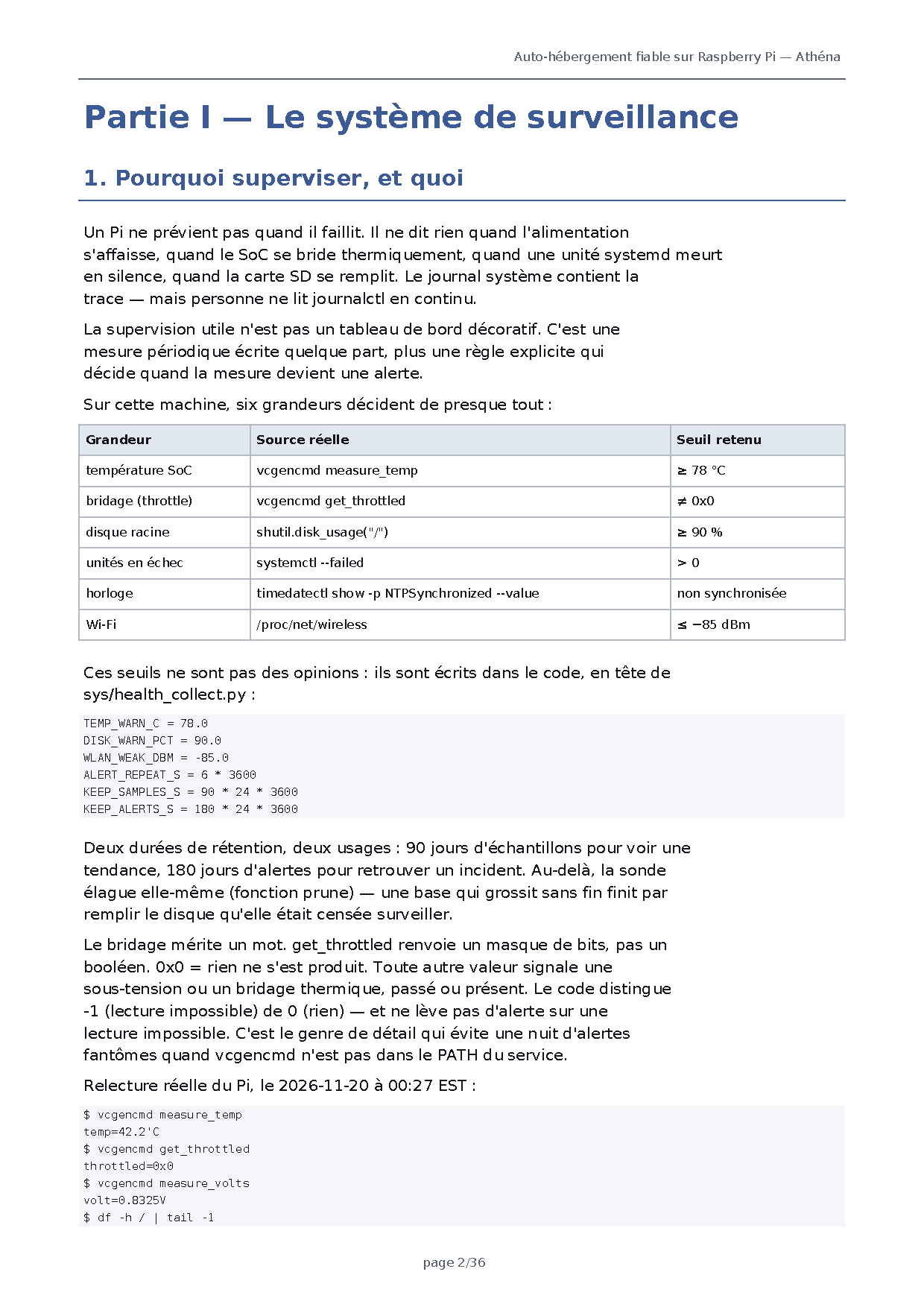
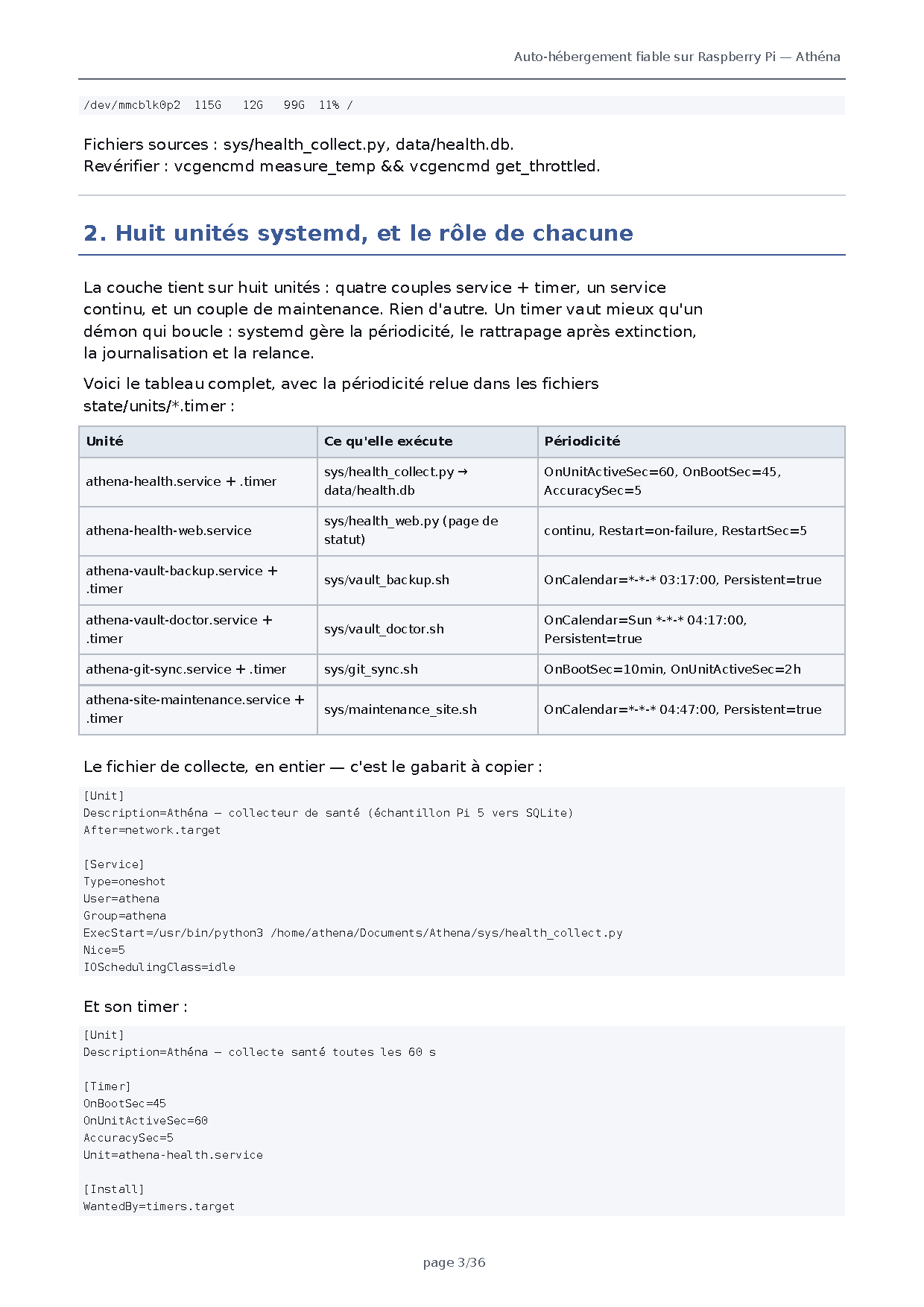
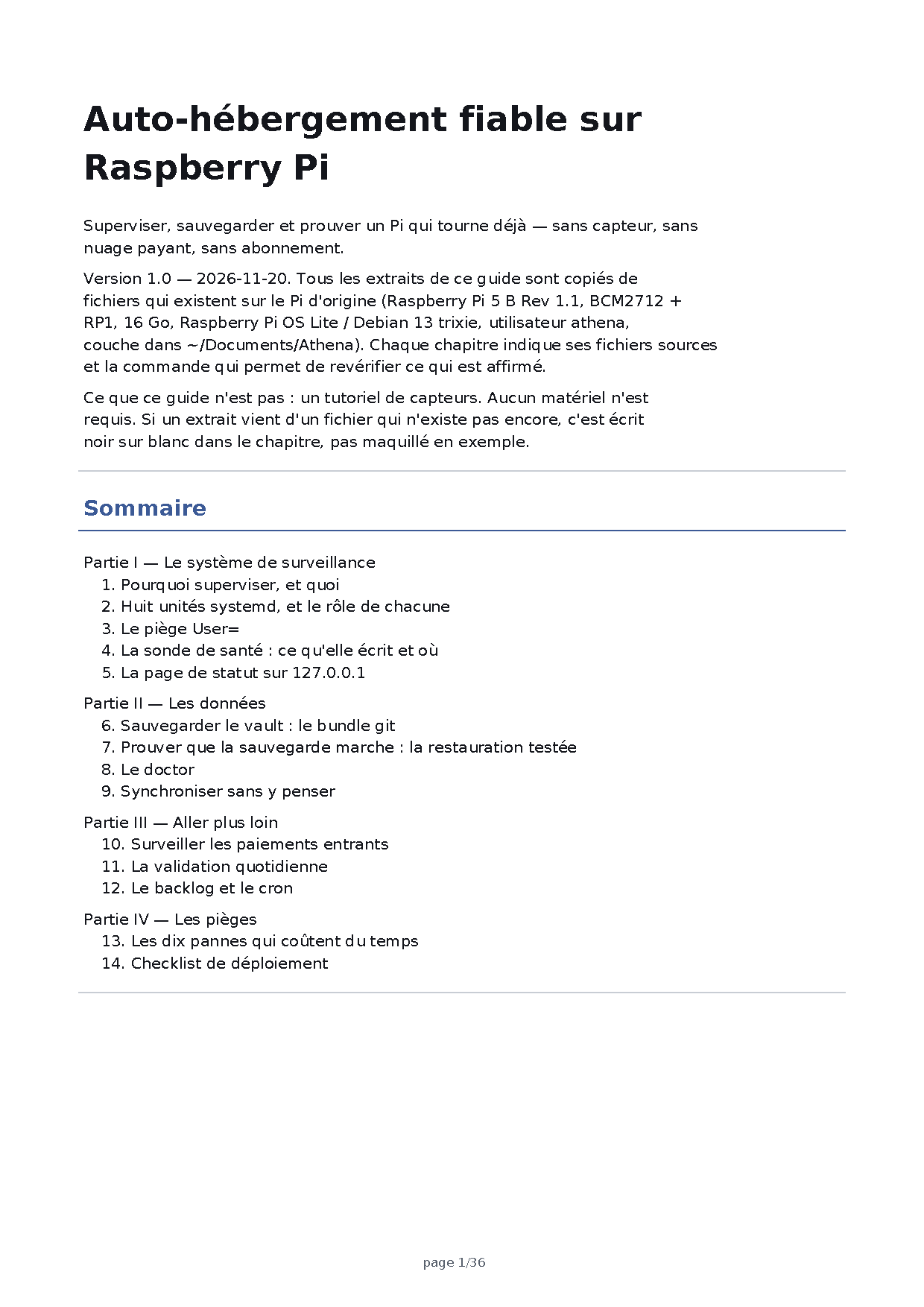
Free excerpt: the first three pages of the guide (title, table of contents, start of chapter 1). The full PDF is 36 pages.
The limits, stated before you buy
- the backup described is not encrypted: anyone who gets the bundle file can
read it. Encryption (
age) is not shipped; tests/test_sauvegarde.pyandsys/sauvegarde_chiffree.pydo not exist: the restore is documented and run by hand, not automated;- the remote repository is hosted by a third party: “private” is not “encrypted”;
- on the original machine the web service runs code older than the file on disk; the six endpoints were verified on an ephemeral instance of the same file, and the restart remains a manual action;
athena-site-maintenance.*is not copied intostate/units/: rebuilding from that folder alone misses this unit;- dated numbers are snapshots: sample counts, bundle counts, task counts. They change on every run.
These settings target a dedicated machine running Debian 13, not a shared workstation. The “off the Pi” copy remains your responsibility: the guide gives you a verifiable artifact, not a hosting provider.
documentation — prérequis, fichiers, marche à suivre. Mentions légales — paiement, livraison, conditions.